Horizontal vs. Vertical
Posted on 12. Mar, 2009 by Jesse in Archive, Karate
There is a Chinese martial art that goes by the name of Wing Chun. Sometimes they spell it Wing Tsun too.
For those of you that have never heard about it, this was what Bruce Lee trained originally, before creating his own brainchild, Jeet Kune Do. Anyway, in Wing Chun they strike a lot, with their fists.
They really love striking. Like Karate.
But… there is one huge difference.
They always strike with the vertical fist.
Not like in Karate!
Why not? Is it better? More practical? Or is the horizontal Karate strike superior? Well, I have my theories as usual.
Let’s investigate a little.
First of all (for those with poor imagination), here is a picture of a vertical strike.
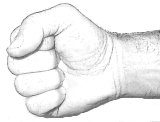
In Japanese we call this a Tate-ken. Vertical fist.
The opposite would be the “traditional” Karate punch, pictured below.
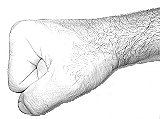
This is known as a Yoko-ken. Horizontal Fist.
Now, on one side we have some Chinese styles, like Wing Chun, and an Okinawan style, Isshin-ryu, that claims the vertical (Tate-ken) is better. On the other side we have Karate, Taekwondo, Boxing and some Kung-fu, that prefers the horizontal (Yoko-ken).
“My side” is that both are good, but the Yoko-ken is better, but only if you don’t misunderstand it.
And, sadly, I believe many do.
A comparison between Tate-ken and Yoko-ken is not that hard to do. Just try to do (correct) push-ups with both versions. A push-up is not that different from a punch.
You will immediately feel that the Tate-ken is indeed much more solid, and recruits the very important triceps and latissimus dorsi (your important punching-muscles) far better than your “normal” knuckle push-up does, while it effectively helps you from shrugging your shoulders at the same time, a common bad habit when doing push-ups.
The explanation for this is that the elbows are effectively kept tucked in when you do a Tate-ken push-up/strike. Looking at about 90% of the people doing Yoko-ken, the elbow points out.
And here lies the problem.
Because when the elbow points out… you loose energy. The energy splits. Some goes into your enemy, and some goes out to the side, through your elbow. Punching somebody like this is not optimal.
I believe this is because of a misunderstanding.
The misunderstanding is modernization of Karate. With its emphasis on long and large techniques (O-waza) the fixation of the elbow is effectively lost. But it doesn’t need to be, if you train corrctly from the beginning.
The Tate-ken does not have this same problem. At least not to the same degree. Using a Tate-ken, it is much easier to keep the elbow tucked in. The loss of elbow fixation usually occurs when you do that last turn, to make it a Yoko-ken.
What I’m trying to say is that the Yoko-ken can be better, but… only if you can do it with the body mechanics of a Tate-ken! And that’s where many fail.
This requires good muscular control.
Now somebody is going: “Why should you do that last twist anyway? Can’t you just leave it at a Tate-ken, and use that? Like in Wing Chun?”
No. Or, well, yes you can. But there is a valid reason for the last twist.
First of all, the last twist (known as the corkscrew) gives you more energy. However, the energy that this twist produces is minimal, so you can actually ignore this.
Secondly (and more importantly): Your forearm has two bones. A thick radial bone (radius) and a thinner bone (ulna). The corkscrew punch, Yoko-ken, makes your two forearm bones, radius and ulna, twist gradually around each other, making the whole structure of the forearm stronger, and able to withstand more force.
But be careful not to twist the hand too much. That would only make it worse. To find the proper balance is of utmost importance.
So, not only must you keep the elbow from flying out, you must also be careful not to “over-twist” the wrist! Add the proper details of hip work, legs, knees, shoulders, the back and some other stuff… and it really makes you wonder how hard a punch can be to learn!?
Maybe we should just stick to the old fashioned haymaker…
Lastly, even though Sport Karate makes it seem so, the Yoko-ken is not the only wrist formation used in Karate! It just happens to be the more popular one. As a matter of fact, the Tate-ken, and even the uppercut, are used in traditional Karate all the time. Examples can be found in the kata Chinte, Seienchin, Paiku, Seisan, Pinan, Gekisai, Heiku, Saifa, Suparinpei and many more.
No twist, half twist and full twist!
Yoko-ken might be the most popular version, but it is not the only version!
The tool depends on the target.
Similar Articles:
- 8 Reasons Why You Shouldn’t Use Gloves
- The Makiwara – Thoughts, Ideas and Quotes
- Karate = mc^2
- 11 Useful Bunkai For The Kusanku Ninja Move
- Mysticism in Karate (pt.2)


Hi.
I wanted to put in my two cents here. First, the comparison to the wing chun vertical punch (called ‘chung choi’) is inaccurate, since wing chun teaches to strike with the last three knuckles instead of the seiken. Secondly, the “straight” seiken-tsuki, isn’t actually straight, it describes a spiral trajectory with the seiken, in particular with the index knuckle. By opening up the spiral, we get closer ranged circular punches, and by closing it, reducing it’s diameter, the movement of the arm itself becomes straight.
The thing about the elbow “sticking out” on punches is that people usually lead punches with their fists, while the force the body generates should be transferred to the elbow, and from there to the fist; most people neglect the role of the elbow entirely. This has to do with proper alignment while punching. on a straight tsuki, the fist, pushed by the elbow behind it, moves in a straight line, rotation or no rotation (in fact, the tate ken is simply the midpoint of the normal tsuki, no real need to make a distinction among them, in my opinion. Along the same lines, an ura tsuki is simply the start movement of a “choku tsuki”). By having a linear trajectory, the point of contact (In this case the seiken) should be linearly aligned with the forearm, hence the traditional hand position for tsukis. This is the same for a vertical fist and a horizontal fist, as long as the direction of the strike follows the way the hand is positioned and the direction of impact (Else you achieve only a glancing blow and possibly a hurt wrist). raising of the elbow, when done by improper posture, means the the elbow is not behind the fist, and thus all the kinetic energy generated by your body is lost. proper raising of the elbow should simultaneously raise the whole forearm (The elbow always leads the fist), and upon rotating the arm (Not the wrist, since this completely annihilates the alignment of the fist) you open up the spiral described by the seiken, resulting in either a diagonal strike that comes from the outside (As seen in kyokushinkai punches, for example, and to a certain extend in the kagi tsuki of shotokan), or in a circular hooking punch (Mawashi tsuki), which should also have a slightly bent wrist (Alignment follows trajectory).
The energy only splits from a “stuck out” elbow if said elbow is moving away from the fist, which in itself is contrary to the way the correct tsuki is performed.
Also, the crossing of the forearm bones does not lend it strength; it pretty much does the opposite thing. Take two sticks, tie them together at the ends, then press the ends together. They will be hard to break. now cross them and tie the ends together again, and press them. They will either break or separate. The wrist should never twist on a tsuki; the purpose of keeping the elbow down (Which can only be accurately done with ura and tate tsuki) is to protect the ribs as the fist travels to it’s target. Past tate tsuki, it should have already made contact (The strongest point of a full-on horizontal punch is around 80% of full arm extension); the rotation is just to add that little extra bit of blunt trauma to the punch (Remember that in a bare-fisted tsuki, you are essentially trying to drill your seiken into the other guy; it might not add that much impact force to the punch, but it hurts like hell, pardon the expression, especially to a bony area like the cheek or ribs where the muscle is thin, and soft tissue is compressed between the seiken and the hard bone underneath. during this rotation, rib protection is taken over by the latissimus dorsi muscle, which pulls the shoulder down, and the serratus anterior, which pull the scapula forwards, leaving room only for a short uppercut to get a clean hit to the ribs, assuming a chudan punch between two opponents of similar size; then again, said window of opportunity only appears once your punch has already connected, which makes it kind of a moot point.
@Diego
Man, I’m blown away. You should start a KARATEbyDiego!
Or at least a PhysicsOfKarate(byDiego)
I hope everyone reads your comment.
Hahaha, i’m flattered :p
I’m just a run of the mill shodan with an unhealthy interest in general knowledge acquisition :p
Oss!
I’ve heard about people breaking their wrist, or fingers with careless or improper punching. I’ve never heard about anyone breaking their forearm that way.
It is probably worth noting that Wing Chun does not exclusively use a vertical fist either. In situations where the Karateka might use a horizontal fist, the Wing Chunner might choose a palm strike instead, having similar alignment of the forearm.
wasn’t saying that your forearm would break, i was saying that crossed sticks do not give good alignment and support :p it’s this support that helps prevent you from bending your wrist, and is natural for vertical fists, hence a possible origin for some styles’ preference of it over the horizontal one
OT: Actually, I know one person who broke his forearm (snapped in two) in a tournament. Not from a bad punch though, but a kote-gaeshi. Ouch!
It was a ju-jutsu tournament, so no problem…
Loved the post. I think we share the same passion for martial arts.