You know how the old masters of Karate would always write noble things like: “The ultimate goal of Karate is to seek perfection of character” and “Seek to improve yourself and your manners” and that kind of stuff?
Well…
Let’s just say that everyone didn’t really follow what they wrote themselves!
Today I thought I would tell you about a historical tidbit, involving two great, legendary, Karate masters who simply couldn’t stand each other. Even though both came from Okinawa, they were complete opposites, like oil and water, which didn’t really help their “friendship” at all.
Actually, they often acted surprisingly much like children.
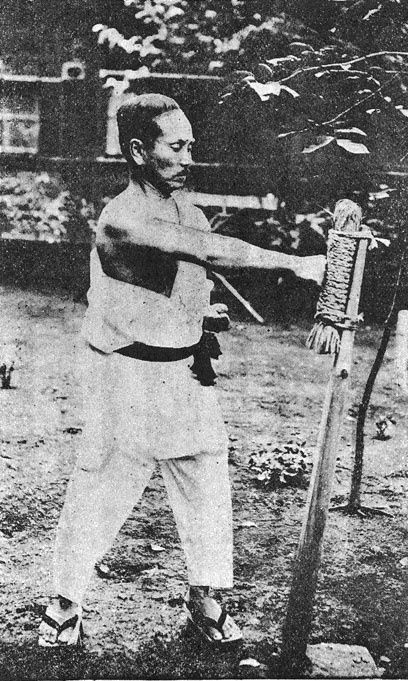
I’m talking about Funakoshi Gichin (1868 – 1957) and Motobu Choki (1870-1944) of course.
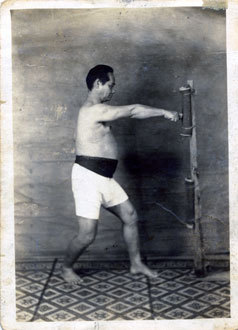
Resembling the Okinawan poisonous ‘habu’ snake and it’s worst enemy, the mongoose, these two famous figures of Karate had something of an epic battle which would easily outweigh most TV dramas of today. However, many people haven’t heard of this because, let’s be honest, slander and blasphemy never looks good.
Especially not when you advocate the opposite.
So, for those of you who have never heard about this story, let’s briefly look at what these masters once said about each other.
According to Motobu himself, it all started on a beautiful day like this:
“When I first came to Tokyo, there was another Okinawan [Funakoshi] who was teaching Karate there quite actively. When in Okinawa I hadn’t even heard of his name! Upon guidance of another Okinawan, I went to the place he was teaching youngsters, where he was running his mouth, bragging. Upon seeing this, I grabbed his hand, took up a position of kake-kumite and said, ‘what will you do?'”
This quote from Motobu was written in “Ryukyu Kenpo Karate-jutsu Tatsujin Motobu Choki Seiden” by Nakata Mizuhiko (translated by Joe Swift) and as you already see, their first meeting was everything but peaceful.
How did the meeting end?
The quote continues:
“He [Funakoshi] was hesitant and I thought to punch him would be too much, so I threw him with kote-gaeshi (a wrist throw common to jujutsu and aikido) at which time he fell to the ground with a large thud. He got up, his face red and said ‘once more.’ And again I threw him with kote-gaeshi. He did not relent and asked for another bout, so he was thrown the same way for a third time.”
Imagine that.
Now, of course there are different versions of this altercation. Here’s another take on the exact same story, found in “Karatedo wo Kataru Genzai no Budo Teki Shiten” written by Konishi Yasuhiro:
“I heard that Motobu met Funakoshi and they talked about how various attacks could be effectively received, when Motobu asked him to show him a block against a punch. When Funakoshi blocked the technique Motobu seized his hand and threw him about three and a half meters. I’m not sure if this is true or not but I do know that since that time Funakoshi hated Motobu very much, referring to him as an illiterate.”
So that’s how it all started.
And as they say, the rest is history.
From this point on, it basically escalated. For instance, after hearing that Funakoshi was issued a 5th dan (at a time when grades barely existed!), Motobu apparently said “If that’s the case then what does that make me, a 10th or 11th dan?”
Sources also mention that whenever Motobu’s name was mentioned, Funakoshi’s face contorted. Conversely, Motobu often referred to Funakoshi’s Karate as a Shamisen (the 3 stringed Okinawan guitar), “beautiful sound, but hollow on the inside”.
As we can see, Motobu was all about practical Karate. You either show what you’ve got, or you get lost.
And that is exactly what he told us:
“He [Funakoshi] can only copy the masters elegance by performing the outer portion of what they taught him, and uses that to mislead others into believing he is an expert when he is not.”
“His [Funakoshi’s] demonstrations were simply implausible. This kind of person is a good-for nothing scalawag. In fact, his tricky behavior and eloquent explanation easily deceives people. To the naïve person, Funakoshi’s demonstration and explanation represents the real art!
Nothing is more harmful to the world than a martial art that is not effective in actual self-defense. If that stupid person opens a dojo then let him fight with me and I’ll make him go back to Okinawa. That would be a real benefit to the world!”
Whoah…
So what can we learn from this?
Well, I don’t really know if there is anything to learn. It’s more like a huge, bad example. Yet, it’s hilarious.
I guess we’ll just have to learn that Karate masters are humans too.
Better a diamond with a flaw than a pebble without.

“No matter how you may excel in the art of the fist, and in your scholastic endeavors, nothing is more important than your behavior and your humanity as observed in daily life.”
– Teijunsoku Nago Oyakata, 1663

24 Comments