Become a Master Teacher – I Dare You
Posted on 22. May, 2010 by Jesse in Archive, History & Philosophy
Long before there ever was planning, there was improvising.
For milennia humans functioned basically only by thinking on their feet, problem-solving in the here and now. Hungry? Go get food. Sleepy? Go sleep.
At some point, however, survival started to demand planning: the cavemen who picked just the berries at hand and caught the fish only as it swam by didn’t make it through long, cold winters. In order to stay alive, early man needed to cultivate the capacity to think ahead and stow away food for hard times.
This groundbreaking development in human history marked the end of improvising as our primary way of life.
Enter the appointment calendar.
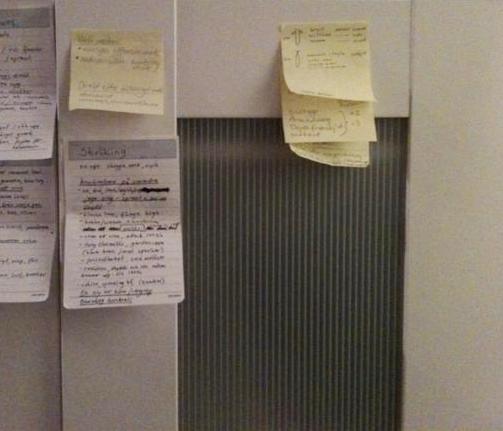
This was what I saw last week when I entered the dojo after a class held by some of our senior instructors.
Apparently, it seems some instructors at our academy feel the need to use small Post-it notes filled with details on techniques and plans for the class. These notes are even so important that they need to be stuck on the walls and mirrors, for everyone to see their holiness.
To me, this way of teaching - besides making you look totally unprofessional – ultimately hinders the progress of both yourself and your students.
An instructor should never be seen with a note in his hand, as long as he isn’t a beginner himself.
(Okay, it’s easy to be humble and say that “we’re all beginners”, but at least a teacher should have more knowledge of the subject at hand than the students, right?)
I mean, imagine you’re going to a boxing gym, and the coach stands with a Post-it note, going “Okay, let’s see what I’ve scribbled down: right cross, left hook, sidestep… and what have I written here… *scratches head* oh, that’s it, a right uppercut! Okay, everyone, let’s work on that combination!”
If I walked into a gym and saw this, I would turn at the door.
I bet you would too.
Now, hopefully this worst-case scenario probably doesn’t exist. But still, making notes for remembering what you’re going to teach for class is a sure way of not evolving as a teacher.
In fact, I think planning ahead in general can be counterproductive.
As I said, for beginning instructors notes and grand plans are okay (but for God’s sake hide them!) but if you strive to one day become a master teacher, then you’ll have to radically change your perspective. Mastering how to manage the dojo and accelerate the students ability in the martial arts – regardless of special learning challenges, learning styles, or age – means challenging yourself in whole new ways.
Challenging yourself as a teacher.
I think Leonardo da Vinci said it best, when he told us:
“Great thoughts are created in small rooms”
We, as instructors, need to limit ourselves. We need to challenge ourselves, push ourselves, and stop being so secure in our positions. Even though the level of the students might not be that high, we still need to think deeper in order to evolve ourselves, and the best way to do that is quite scary.
Ready?
Don’t plan anything.
I really mean N-O-T-H-I-N-G.
Don’t even plan the lesson/class it in your head. And absolutely not on Post-its! Think like an artist.
I know this sounds really bad. It sounds like the class will be really messed up, with everyone doing nothing, because “you haven’t planned”. People standing like zombies, not learning anything, or even leaving in the middle of training.
But it’s the exact opposite.
Like da Vinci reminds us, by not having any notes or plans as a backup (not even hidden notes!), we are forced to make smart, improvised decisions on the spot, by smoothly and professionally evaluating the situation (preferably as the warm up is starting), in order to find the main theme for the lesson.
And when that theme is found, the rest of the class will work itself out very well, as long as you’re alert and find the flow of teaching (which isn’t always as easy as it might sound).
Better than it ever could have if you’d planned it.
Because improvisation and creativity go hand in hand.
And that’s why I’m saying right now that this is only for advanced instructors. No, not even for instructors – for teachers. To me, there is a difference between an instructor and a teacher, and by not planning anything at all for the class in advance, you are taking a big step towards one day becoming a master teacher.
A master instructor can have notes.
A master teacher can’t.
Because he knows it won’t help him anyway.
So, to sum it up, the plan is… Don’t plan. Like we humans were meant to do from the beginning, remember?
Improvise.
Challenge yourself.
Civilization has gotten further and further away from the so-called ‘natural’ man, who uses all his faculties: perception, invention and improvisation.
So cultivate your inner caveman.
I dare you.
Similar Articles:
- The 2 Golden Rules for Karate Instructors
- My Way of Teaching – Hate It Or Love It
- Chibana Choshin – Butoku
- The Evolution of Dancing. And Fighting.
- Siam – Discovering Karate’s Forgotten Source (pt. 1)


I have long held the opinion that “Civilization has gotten further and further away from the so-called ‘natural’ man, who uses all his faculties” -and that we should all cultivate our inner caveman.
Great article!
Great article, yes. You have some interesting points, but I still disargree. Besides the caveman-bias (I guess you put that in just for rhetoric reasons), I think you are discarding notes too quickly.
I see notes much like MS Powerpoint. Powerpoint can be a great asset to almost any presentation, but usually the referent is
-pulling the “powerpoint-magic” way over the top.
-not using PP to aid, but to replace a proper lecture.
In very few cases a Powerpoint presentation really does what it should: present the basic information as a thread for the audience.
Now Powerpoint is very public, while the notes you are talking about aren’t nessecary, but they still got one in common: both are often used in a counterproductive way.
But can notes still be a benefit ..to a master?
I think so. I see notes as a way of “outsourcing” information from your counsciousness. This can be very helpful for coordinated working and researching; best example is Umberto Eco and his index-card-approach. Now by doing this outsourcing several errors can occur, for example:
1) Construcing a false reality by simply giving it a wrong name (google for Linguistic Turn).
2) Stopping to verify the (outsourced) information and become blind for changes (in your perception and method).
3) Get distracted from the actual thing that is supposed to be aided by notes, just by bloating the whole note-writing-process way too much.
3b) Losing your own view by tons of information you can’t process properly (seriously, anyone reading this is most likely only human).
4) Become complacent by your pretty notes and lose your “edge” (you know what I mean?).
Those are only the first complications that pop up in my mind, but you already see, it’s tricky. I argree that notes can turn your lesson into bullsoup and that improvising can be the greatest thing, but it’s also occurs the other way round. It’s not the fault of the notes, but the fault of careless people who think their notes or whatever could replace knowledge, but I see it as a fact that a note that isn’t backed up by the adjacent knowledge is worth less than a wet fart. You get my point? I may be talking around it, but what I want to say:
Notes are tools that can trick you. If you let them trick you into a false security or “backed-up feeling”, they turn your concept to dirt. But if you use them with *precision* and care notes can be a mighty way of sustaining your theoretical edifices.
Cheers mate!
Replace Umberto Eco by Niklas Luhmann and it’s alright.
Well, if you – like me – believe that teaching in its higher form(s) is more of an art form than an isolated, sterile, laboratory skill – then notes, Powerpoint presentations and bullet point spreadsheets can only take you so far (which in some cases can be very, very far, actually). But, it is an inevitable fact that to become/evolve into an über inspirational “master teacher” one will eventually have to abandon these mnemonic aids in accordance with shu-ha-ri.
I see our belives differ vastly on this topic. My belief is that art requires skill and doesn’t compete with it (and I am aware that art is a difficult term, so I hope we don’ talk at cross-purposes now). So I presume your opinion is that karate should be learned and taught by intuition and not by systematics. I argree insofar that cultivation of intuition plays a major role in the subject of karate. But I don’t see how it contradicts the concept of shu-ha-ri.
Please let’s not talk about inevitable facts.
Ps: About art — I know we are living in a time and culture were anything can be considered art; now the term usually is used to an extent, that it gets the “aftertaste” of something diffuse which has no other/defined purpose than the purpose of being art/having no purpose. Now this thinking may have come up with cubism, which featured a whole new direction of aesthetics. People maybe thought “what crap is this?” and because they couldn’t find an easy aswer, they got the impression: indefinable + no common use = art. I think that art is an expression of the most inner human being and that makes the form of art so undefineable.
And that makes the term of art not the opposite of systematics.
Because also systematics can express our inner. That’s how the brain works: constructive. And that’s what art features: the most individual and personal construction of .. our stand and point of view in the world.
Art requires great skill indeed! It is a prerequisite.
But, for instance, when you know how to write, you don’t need to look at the alphabet anymore, right? Last time I recited or looked at the alphabet I was in the first or second grade. And in the article I was trying to make the point that some people might still be holding on to the “alphabet” even though they could basically write a book if they just let go. Let their hair down, so to speak…
I am sure you agree with this?
That I believe Karate should be taught by intuition and not by systematics is a faulty presumption, though I definitely think a systematic approach should always incorporate elements of intuition and exploration in various degrees (see periodization).
Interesting topic for sure!
I couldn’t argree more, but just for discussion’s sake:
When you never saw an alphabetic order, but have to learn writing by conclusions from the “final” words, would it be different?
Maybe you will be able to conclude that you will never find a “Schlop” (Schloß) in Germany..
..and then you stumble over futhark.
And what do you mean by periodization? I’m not familiar with that.