Today I was looking through my library, trying to figure out which martial arts books I haven’t read in a while.
One of the books I looked through was “Watashi no Karate-jutsu” by notorious Karate pioneer/brawler/scholar Motobu Choki, which happens to be one of my favorite books. It’s a great read, containing many gems, and the somwhat rugged personality of Motobu really shines through in some places.
The book is seriously a must-read for Karate enthusiasts.
But that’s not what I want to write about right now.
What I want to write about is Karate’s obsession with ‘stances’, In Japanese known as tachi (or -dachi if preceeded by another word). You see, when I flipped through Motobu’s book today, I noticed something really funny, that has got to do with stances.
In a paragraph entitled “Collection of Sayings by Motobu Choki”, the following can be read:
“#34. There are no stances such as neko-ashi-dachi, zenkutsu-dachi or kokutsu-dachi in my Karate. Neko-ashi is a form of “floating foot” which is considered very bad in Bujutsu. If one receives a body strike, one will be thrown off balance. Zenkutsu and kokutsu are unnatural, and prevent free leg movement.”
Now, what do I find funny about this?
Nothing in particular.
But… when you read a few pages further, when Motobu demonstrates some typical old Karate self-defense techniques, something interesting happens.
He starts to use stances!
Which he, just a few pages back, claimed he doesn’t.
Don’t believe me?
Well, see for yourself:
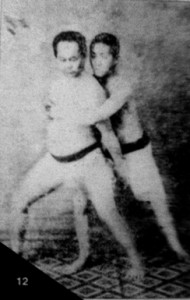
An escape from a rear bear hug, with a picture perfect zenkutsu-dachi.
I even drew some red lines to make it clearer:
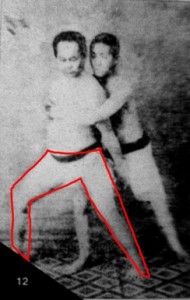
If this isn’t a zenkutsu-dachi, then I don’t know what is!
But wait, there’s more.
Look at this neko-ashi-dachi, that he apparently “never uses” because it “is considered very bad in Bujutsu”
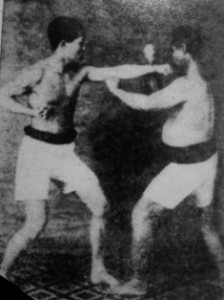
(Okay, so he doesn’t actually lift his front heel, like we do today in our modern form-orientated Sport Karate, but the weight is clearly centered above the back foot, which happens to be the purpose of neko-ashi-dachi)
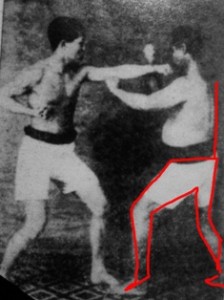
You thought that was all?
I’ve actually got one more zenkutsu-dachi (a variation of the first one):
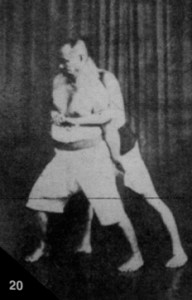
And with some red lines:
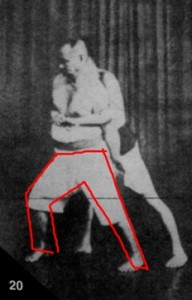
So what’s up with this?
Was the great Motobu a lier?!
Did he write that he “never uses stances”, only to secretly love them?
I don’t think so. However, what I do believe is that Motobu often used several different stances (as indicated in the pictures above), but he made a simple mistake that everybody who practises Karate makes now and then.
He confused function with form.
Form with function.
And from that simple misunderstanding stems the never-ending debate on Karate and its stances. Modern desktop warriors battling on forums, keyboard fighters arguing on websites… I mean, you only need a quick Google search to find the following:
“[…] karate is a joke. Its useage of classical stances and lack of speed make it a very impractical […]”
–sidekicks 83
Or how about this:
[…] complex series of impractical stances and poses, are typical of traditional martial arts, and anyone practicing such crap would be killed if he fought a real […]
-Defendu
I could find so much more, but I wouldn’t want to give them more space on the internet even if they paid me.
On the other hand… when you think about it, maybe our precious Karate stances really are somewhat impractical. I mean, maybe they are right? You could never execute a swift kick from shiko-dachi, right? Or how about trying to throw a big, hard, right hand knockout punch from neko-ashi-dachi?
Good luck doing that!
But here we go again: Acting foolish.
Because now we are again, just like Motobu, confusing ourselves with the real purpose and use of the different stances.
From the beginning, the function of the technique dictated how the form would look like. Constructing some kind of form from a blueprint was never the goal. Today, it is the opposite. We are reverse-engineering everything based on stances that we don’t even understand to begin with.
We are trying to do things, but we are using the wrong tools.
A house will never be stable if built on quicksand.
So I figured, since Karate has this obsession with stances, and some uneducated people like to pick on that, how do other martial arts do?
I took a look.
And here’s what I found:
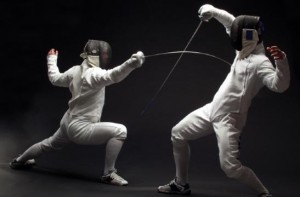 This is Western fencing.
They call this move the “fente”. Or simply “the lunge”.
They do not care how many degrees the toes should point somewhere, or how wide or long the stance should be. The point of the stance is to reach forward and stab the opponent. How the stance (form) then looks is up to you, as long as you reach your goal (function).
We would call it a zenkutsu-dachi.
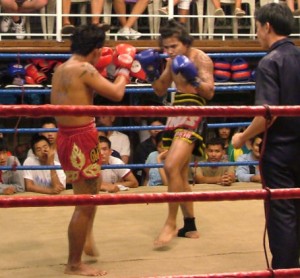 And what do we have here?
Two Thai boxers preparing to exhange vicious blows with each other.
But look at the feet.
The stance they use is called Jod Muay, meaning “fighting stance”, focusing heavily on being light on the front foot (for quick kicks, checks, blocks, parries and knees) while remaining heavy on the back foot.
In Karate, we would call it a typical neko-ashi-dachi.
For the purpose of Thai boxing, experience has shown it is the perfect stance.
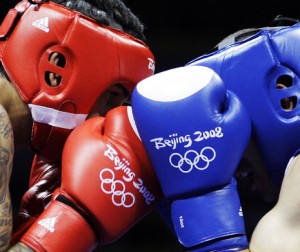 And here’s some regular modern Olympic boxing.
Now, I didn’t find a good picture of it, but when two boxers are in an infighting exchange, using short, fast techniques like uppercuts, body blows, and hooks, guess what stance they are using?
The short range boxing stance would be what we call sanchin-dachi. Perfect for close quarter, core muscle-dominated fighting.
But since I didn’t find a picture, you’ll simply have to believe me.
 And finally, the last martial art that I’m “borrowing” stances from:
Wrestling.
Using the best stance for Wrestling means finding a good balance between stability and mobility. You must be able to withstand your opponents attempts at takedowns, while simultaneously being able to bring down the opponent.
There is even a saying that goes “Without a good stance, a wrestler doesn’t have a chance”
The answer lies in what we Karate people refer to as kiba-dachi.
————————
So, what do we make of these four different “Karate ” stances that other martial arts use?
Karate, being highly influenced by the Japanese systematical “everything-must-be-cut-to-pieces-and-fit-into-a-box” mindset, has 20-30 stances, neatly divided into several different categories.
But in reality, nearly every other martial art has this plethora of stances too.
They just don’t focus on the outside that much. They never cared about dividing everything into categories, divisions and fields.
Other martial arts (often more modern ones) still have their original goal known to the practitioner – which happens to be beating an opponent. And to do that, you only need a basic understanding of the underlying form. The stance, or kamae. From there you evolve, and your techniques will allow you to freely flow into different forms, depending on the situation.
When it comes down to it, mastering how to control your bodyweight in different scenarios is all that you need. Accomplish that, and you’ll never have to think about stances again.
Because that’s the whole point of stances anyway.
“When one has reached maturity in the art, one will have a formless form.
It is like ice dissolving in water. When one has no form, one can be all forms; when one has no style, he can fit in with any style.”
-Bruce Lee
It is important to learn forms and stances, but it is equally important to forget them, once the meaning behind them has been absorbed.
Or else you might never go beyond what Bruce Lee once called the “classical mess”.

23 Comments